metaphoricallove

wisdom is chasing her – but she's faster.

Baqar Khani Uncle rang our doorbell every day at 6:00 p.m.

It often felt as though he carried the secrets of the universe in the large woven basket resting against his hip.

I knew the usual suspects by heart: a crate of eggs, a loaf of bread. But tucked among these ordinary staples was the one thing I yearned for.

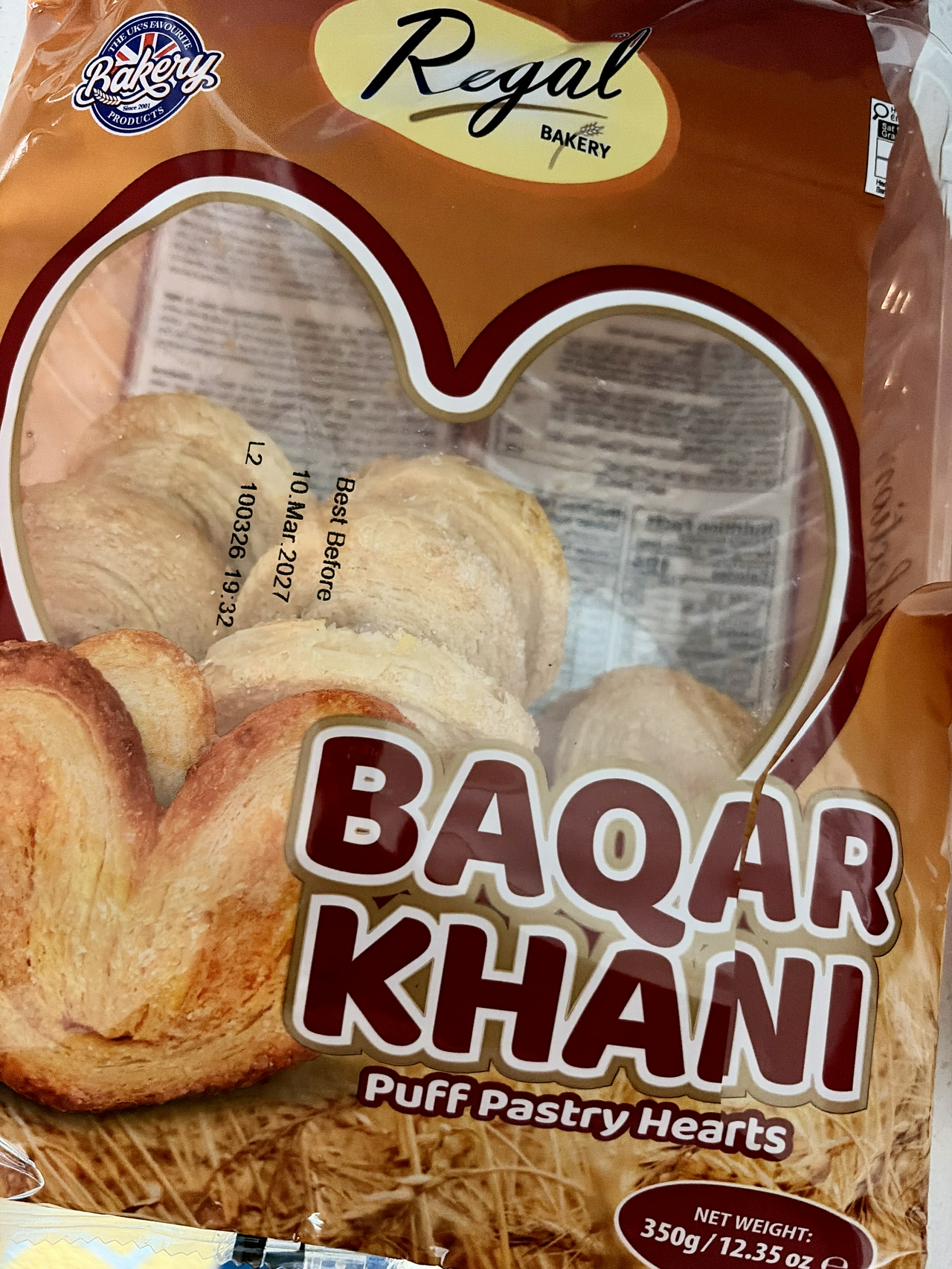
With its irresistible, barely-there flakiness, Baqar Khani was a stubborn ghost fighting for its right not to be.

Bold sugary granules led the opening attack, they tricked one into thinking the pastry would be easy to grasp….all sweetness, all promise. The first chew, however, revealed something far more complex: a pastry nearly impossible to pin down.

As I write to you, these memories feel equally elusive, buried beneath fluorescent certainty and grocery chains.

Still, every now and then, I stumble into a chaotic Pakistani grocery store and experience the same irrational thrill: perhaps this time, I’ll finally find some good old-fashioned Baqar Khani.

Earlier this week, chasing that familiar high, I dragged my partner through eight hundred square feet of pure chaos. He followed dutifully, his arms overflowing with crinkling packets of the stuff.

By the time we got home, I already knew what I wanted to do with them.
Recipe

The goal isn’t to use Baqar Khani merely as decoration, but to bring a classic tea cake together with the pastry I have always associated with peace.

Ingredients

Cake:

  • 113 grams salted butter (softened)
  • 160 grams brown sugar
  • 2 eggs
  • 1 tsp vanilla
  • 180 grams all purpose flour
  • 1 tsp baking powder
  • ¼ tsp baking soda
  • 120 ml evaporated milk

Topping:

  • 1 cup Baqar Khani (crushed chunky, I did it with the back of a wooden spoon)
  • 2 tbsp brown sugar
  • 2 tbsp melted butter

Instructions:

  1. Preheat oven to 350 degrees Fahrenheit.

  2. Cream the softened butter and brown sugar until smooth and spreadable.

    • Soften your butter before starting this step. You'll know it's ready when pressing a finger into it leaves a dent.
    • Also please use a deep mixing bowl for this – I didn’t and I was scraping sugar off my kitchen countertop, not fun.
  3. Whisk eggs into your butter sugar mixture, until the batter is smooth.

    • Pop your vanilla essence in at this point, or don’t – I forgot, it was fine.
  4. Prep dry ingredients in a separate bowl

    • This is the fun part: just toss the dry stuff together (your flour, baking powder, and baking soda). If you’re fancy, sift. I’m not fancy, so I dumped.
    • Please remember to weigh your ingredients with a food scale (if possible). This is not fancy, this is a necessity because we’re dealing with chemistry.
    • I failed grade 11 chemistry, btw. So you can trust me on what not to do.
  5. Fold the three amigos together in one bowl: dry ingredients, wet ingredients, and the evaporated milk.

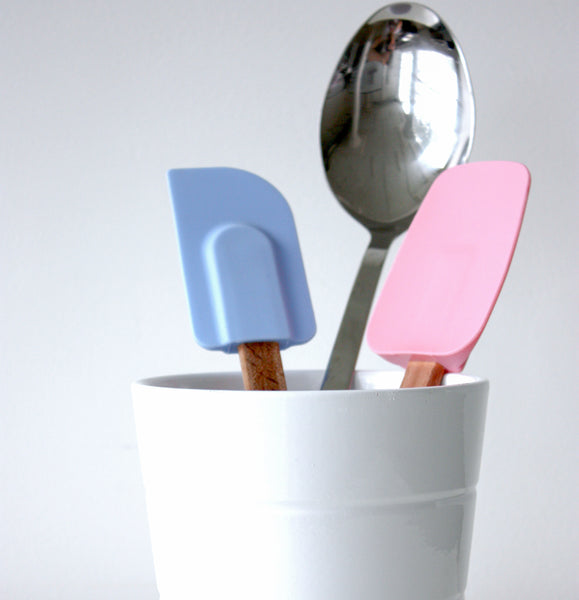
    • Use one of these folders, they’re great for…Folding.
    • Tiny note on technique: Add one-third of the dry ingredients to the wet mixture, followed by one-third of the evaporated milk, and gently fold until just combined. Repeat until everything has been incorporated and the batter is thick and smooth.
  6. Pop the cake mixture into an 8-inch cake pan, cover with the Baqar Khani topping.

    • The topping components should be mixed together before you add them on top of the cake.
  7. Send your child to the mines for 40–45 minutes, or until a toothpick inserted into the centre comes out clean.

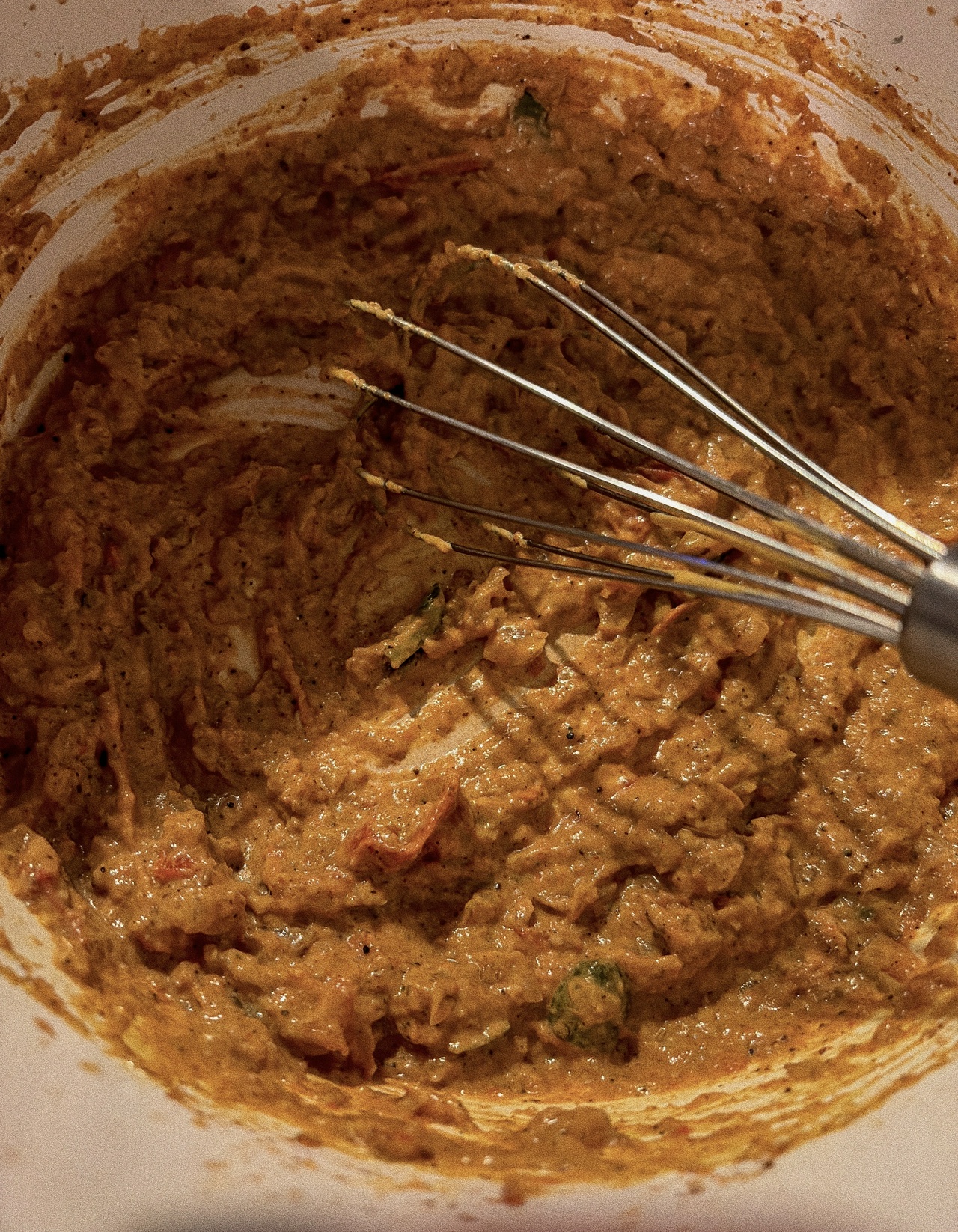
My cake looked like this:
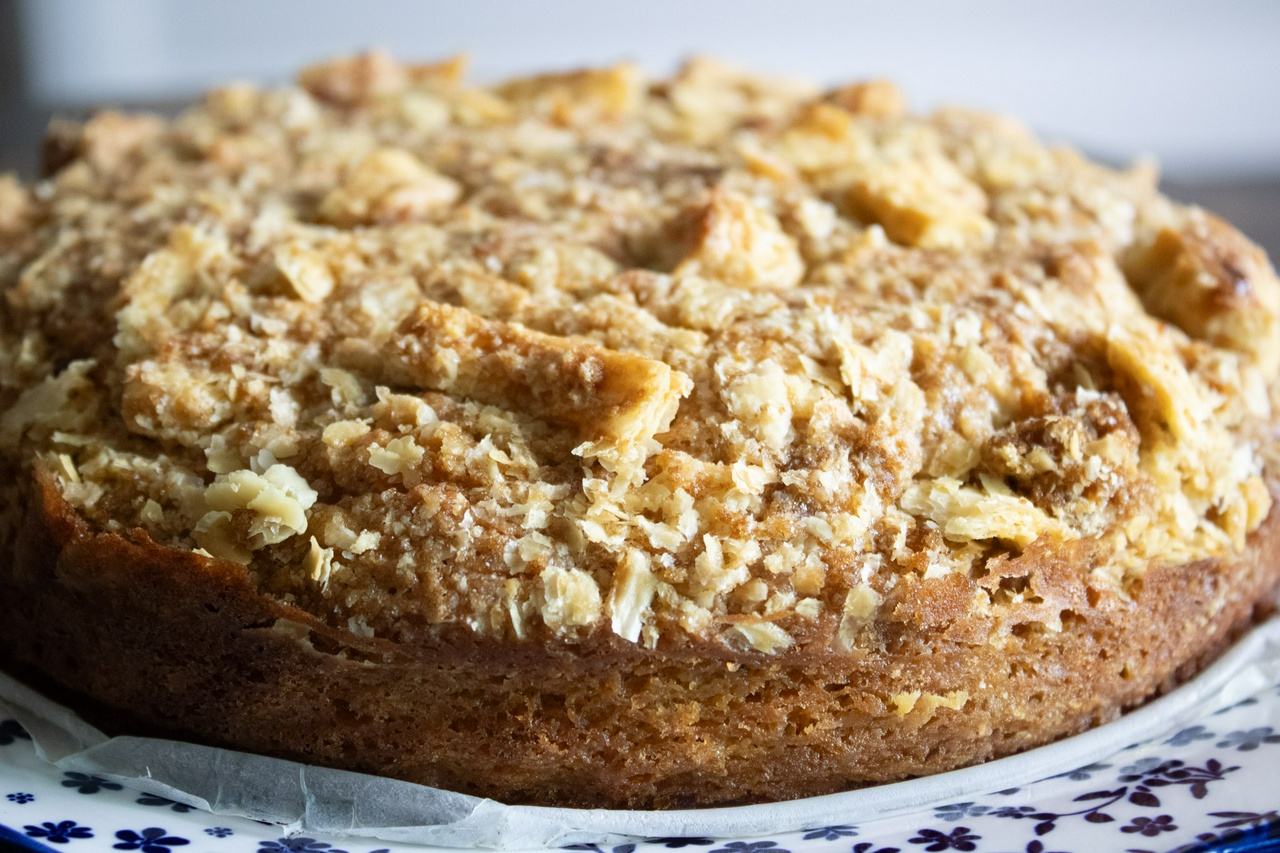
If your cake doesn’t look like mine, eat it anyway. Baqar Khani has never been particularly interested in being pinned down.

Happy baking!

Xo,

M
To be

a scarf hunched on his shoulders,

pin clasped to lapel,

socks peeking through cuffs;

To be

a dent in the mattress, a chip in the glass,

a dash cam comrade;

to float

as an extension,

to pass

as a ghost,

should be enough,

ought to be enough

And yet,

you are:

chip cradling gold: Kintsugi.

A house of mirrors shattered by

the immovable pea.

Our gladiator's victory scar,

smoke imprinting on skin:

Not to be,

not to be,

not to be.

in my spice cabinet

cumin sits next to cinnamon,

dill next to clove.

shelves unlabelled,

contradictions coexisting,

once stood tall in dreams.

in reality, heat pinned my tongue.

chilli split the air,

the mouth braced,

awaiting cold relief.

none came.

sensation thinned,

sound dulled.

These days, I practice

keeping my mouth open.

letting bitterness bloom,

the roof of my mouth

hardens into refuge

for unsettled flavour.

cinnamon above oregano,

basil beside the nutmeg.

nothing rearranged.

Mojo Jojo is on a rampage, yet again.

Laser beams shoot out of his eyes as he attempts to conquer Townsville. My eyes are glued to the screen hovering above me. I know he won’t succeed. He never does. Even so, I dig my palms into the futon and lean my head forward in anticipation, my mouth agape.

I am hungry.

At this stage in life, food is simple. I desire it, but I don’t yet understand it. I know how instant noodles are made. I know how french fries are made. That’s about it.

A spoon heads straight for my mouth.

It appears without ceremony, without explanation. It is simply there. Warm. Deliberate. Inevitable.

This is how care first arrives in my body: quietly, without asking me to name it.

Sutr means thread. A string. A strand.

On its own, sutr is not a particularly sturdy word. It must be wound and stretched, coaxed and held.

This process gives birth to Sutriyan (soot-tri-yaan)

For a long time, they were a mystery for me. I simply remembered their taste – savoury, warm, chewy.

Feeling precedes naming.

I encountered them again when I was sixteen, sometime after midnight. I had spent the day on my feet, cashing people out, counting change, wiping down counters. When it was quiet, I hid in the back room with my biology notes spread across a crate, memorizing diagrams I hadn’t made sense of yet.

I was tired, with a hunger that felt dull rather than sharp.

When the bowl was placed in front of me, I recognized texture first.

In Deccani Hyderabadi cuisine, sutriyan are the underdogs.

They are not particularly boastful or debonair, like Hyderabadi haleem or biryani, nor are they complex or misunderstood, like sheer korma or baghaar-e-baingan.

Sutriyan are, traditionally, a way of using what already exists. Leftover rotis. A pot of broth that’s been simmering quietly. The kind of meal that assumes more than one body in the house, more than one plate on the table.

We don’t live like that.

There are no leftover rotis here. There is nothing waiting in the fridge to be repurposed. So I knead the aata myself. Roll the dough. Cook fresh rotis one by one, only to tear them apart again.

I create the conditions the dish requires in a space that does not naturally produce them.

The process takes nearly two hours.

Halfway through, I can’t shake the feeling that I have worked against the grain of the recipe rather than with it. I turned something meant to be economical, collective, and quiet into a small act of insistence.

Time stretches before us, and tiny fissures occupy the spaces left behind.

In another life, this recipe would have taken fifteen minutes. In another life, there would have been leftover rotis folded into a cloth, a pot already half-full, a house calibrated for reuse. Instead, I work slowly, deliberately, recreating a logic that no longer fits how we live.

My mind latches onto a memory fraying at the seams; it clings to a world that precedes distance and precedes efficiency. Once you’ve spotted fracture lines within a structure, it’s difficult to pretend they aren’t there. You can still show up. You can still participate. But the spirit, the assumed camaraderie, no longer arrives on its own.

The cooking does not stop, although some ingredients are missing.

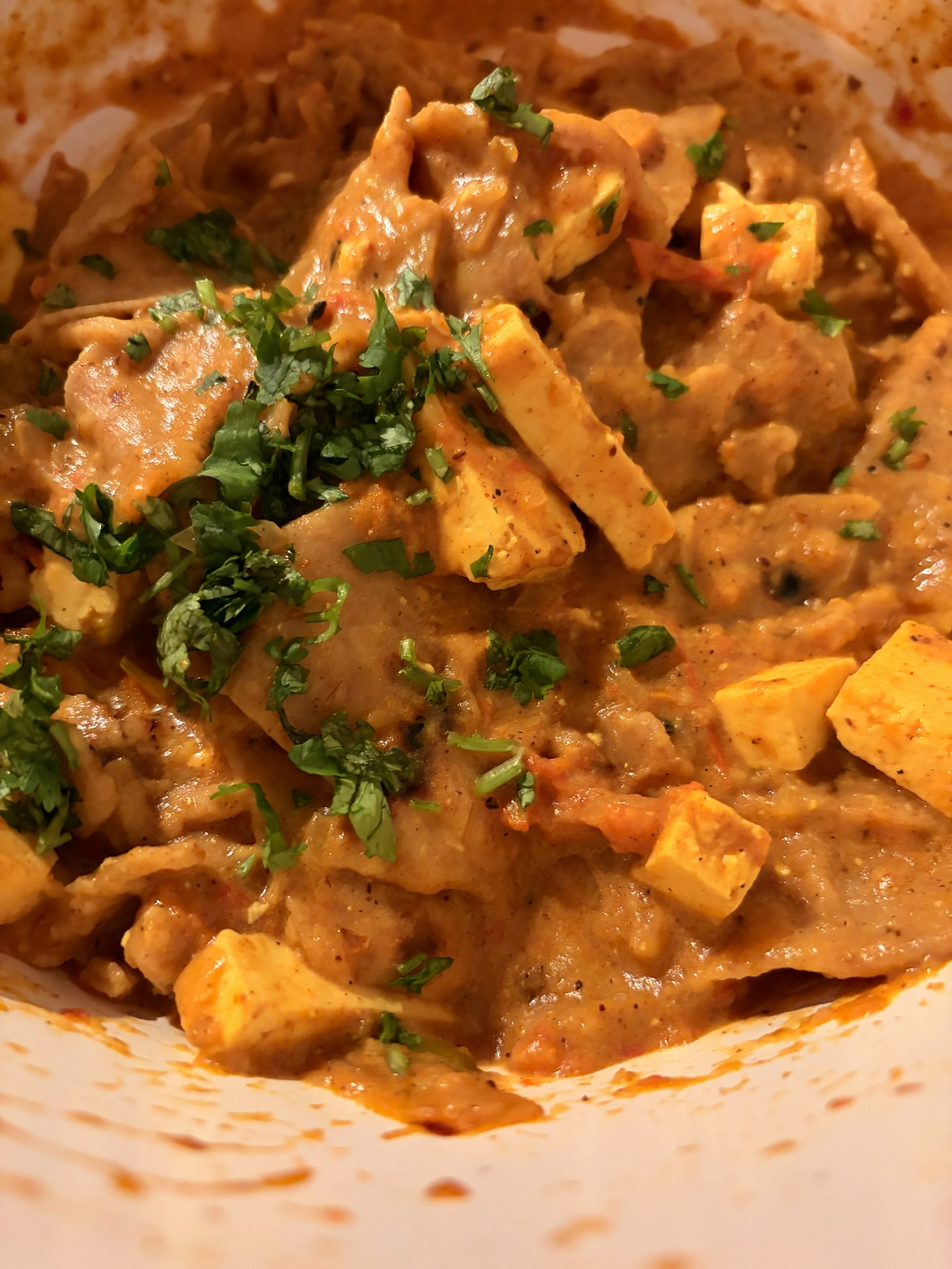
Halfway through, my fiancé runs out to grab paneer – an errand that takes five minutes because the grocery store is directly across the street from us. Walkable. Casual. A form of convenience I haven’t experienced in many years, and am only now learning to value. He returns without ceremony, slipping back into the apartment as though he never left.

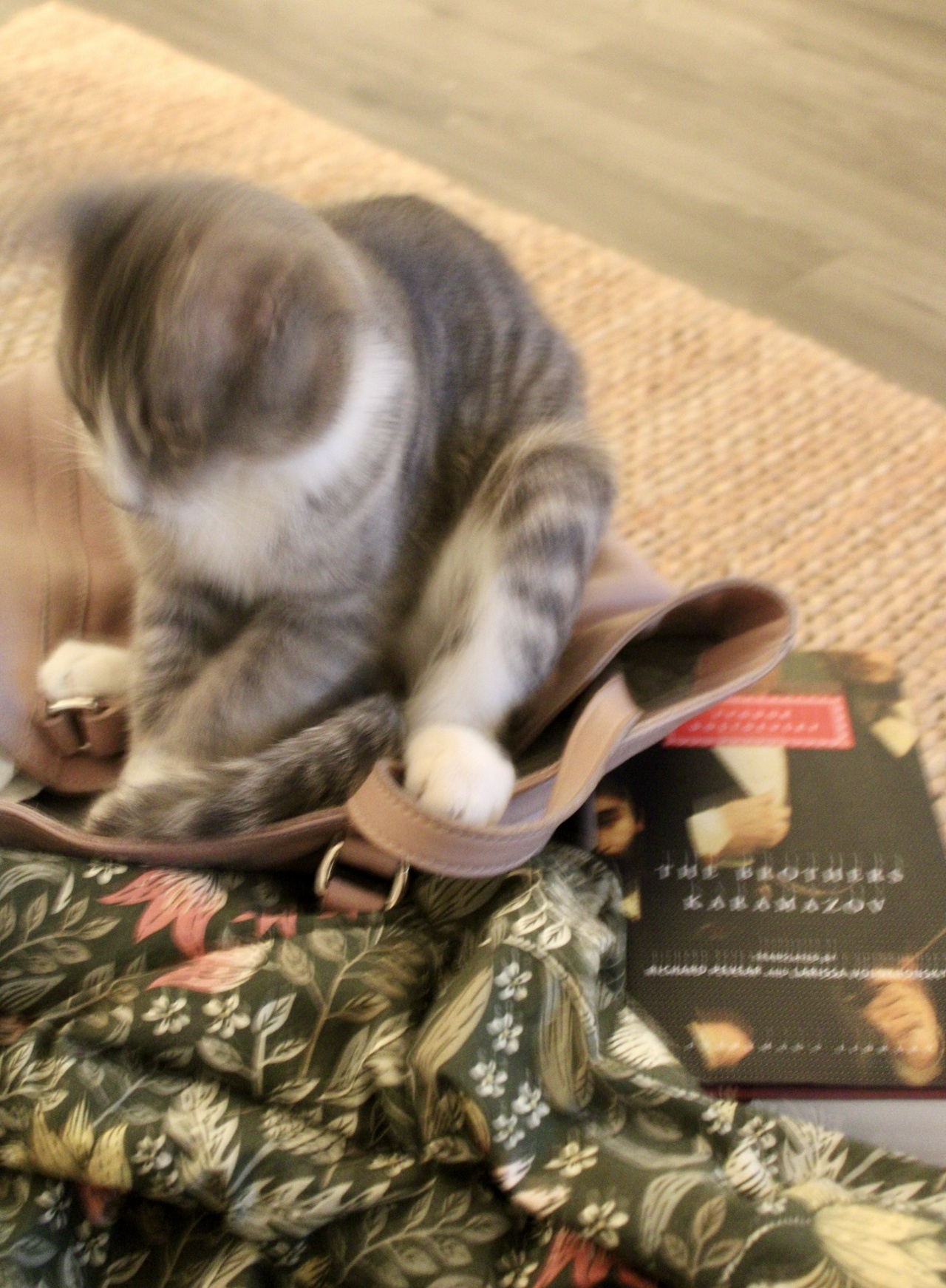
In the meantime, our kitten discovers the stovetop.

He jumps up with the confidence of someone who has unlocked a new level. I scoop him up, gently lower him to the ground – and make stern eye contact to show him that this isn’t okay.

He does it again.

This, too, becomes a game – one I protest, one I secretly enjoy.

The yogurt waits in the bowl. I lower the heat. My hand hesitates before stirring it into the onion-tomato mixture, my heart thudding with the unreasonable fear that it will curdle and ruin everything.

It doesn’t.

Sounds emerge from the living room: a vlog of an Uber Eats driver. Youtube content floods our home like a makeshift ritual. We don’t discuss why. We don’t need to. Slowly, and without much fanfare, time does what it does best when we stop rushing it.

The two hours are arduous, yes. But they are also charged.

By small returns. By new habits. By interruptions I don’t resent.

When we finally sit down, our bowls are modest. Two spoons. A tiny table. A mini can of Pepsi Zero sweating onto the surface.

Nothing about this resembles the world that sutriyan were designed for.

And yet.

Care still finds a way in.

My partner raises a spoonful to his mouth. I hold my breath, my eyes tracking every micro expression on his face.

He sinks his spoon into the bowl for another bite before lightly remarking:

“There will be no leftovers tomorrow, I’m going to finish this tonight.”

My thoughts pause mid motion, and hunger dissipates:

sans fanfare,

sans abundance,

sans efficiency.

I have been fed.

And can you blame her?

Can you blame her for seeking refuge in the gaps

a home that recognizes her form,

that is: no form at all.

A truth too sharp,

a truth too bitter;

a truth soldered and squandered,

pressed thin enough to swallow -

and can you blame her?

Can you blame her

for slipping into void,

into space,

into shapeless hollows,

into the unbecoming

where even the echo forgets her name?

Can you?

Tout le malheur des hommes vient d’une seule chose, qui est de ne savoir pas demeurer en repos, dans une chambre. – Blaise Pascal

When you don’t control the words, and the words don’t control you -

you are experiencing a stalemate with The Creator.

A few years ago, my hyper-fixation on chess gained its resurgence (courtesy of the pandemic, and one too many aspirational Netflix shows). It’s a neat little game, with many moving parts. If you aren’t careful, you may find yourself spending more time getting lost in theory than in practice – and where’s the fun in that?

Nevertheless….

One of my favourite chess concepts is that of the stalemate. So let’s talk about it.

In essence, a stalemate is the game telling you that you cannot force someone to move into their own death (a deceptively benevolent offering from an otherwise ruthless environment).

To me, the stalemate has always been the ultimate mercy call masquerading as constraint; a reminder that even in a world built on force, not everything can be compelled.

So what does one do, when faced with such an outcome?

To be honest with you, my dearest friend: I do not know.

There are moments when the sentence refuses to move – the ideas don’t block me, but they do hold me into stillness. I cannot abandon them any more than they can provide me meaning, and yet….

we stay with one another, the words and I, circling the same quiet square on the board.

We also circle the same quiet truth, one we know all too well in our weary, decrepit bones. A truth that is stranger than time and kinder than witnessing:

A stalemate is not the death of motion, it is its recalibration.

It’s precisely within this recalibration that something else begins to emerge. A truth giving birth to another:

Movement does not cease simply because it cannot be witnessed.

And perhaps that is the real mercy buried inside every stalemate: that while the board appears frozen, while the sentence lies dormant, while The Creator Himself seems unwilling to intervene – something unseen continues.

Motion, I’ve learned, often begins long before it becomes legible. And when it finally reveals itself, it does so with the gentlest of gestures: a sentence leaning forward, just enough for me to follow.

So it goes.

You drill into my knuckle. A power drill—moving slow.

Our eyes lock as bone splinters: crunch.

I don’t feel it – though I know I should.

You don’t notice -

The drill continues turning: steady, clockwise. My knuckle is a crater.

You pause only to brush the dust of me from your shirt.

I watch the fine powder settle on your collar – my bone, my blood, a pale constellation.

Still, I don’t flinch.

You ask if I’m comfortable. Your voice is gentle, as though we were sitting over tea.

The drill hums in your hand, waiting.

I nod.

Because what else is there to do, but agree?

I am as hollow as the crater.

As hollow as your smile.

As hollow as the slow, steady turn that will not stop until nothing of me remains.

  1. Sensitivity might be overrated, but that doesn’t erase its presence. I think of it like polyester: overrated, awful for your skin, and generally problematic—but undeniably real. Ignoring it won’t make it vanish….It’s here —so the question is, what are we going to do about it?

  2. My void is far more accessible than yours – let’s set all the voids on fire.

  3. I’ve started laughing at the monsters underneath my bed—largely because they’re so awful, it’s comical. What’s a girl to do? I can’t tell if this is terrible or reasonable.

  4. For better or for worse: Community. In my case, for better – thank God.

  5. Perceptiveness is a curse.

  6. Everyone wants to start a cult these days – always – all the days.

  7. My company is wonderful (for me), like a safety blanket: Never loud, rarely messy, always safe. Chat GPT tells me that polyester safety blankets can last for 10-20 years before they become safety hazards. I think they’ve always been safety hazards, what -isn’t– a safety hazard these days?

  8. The urge to whip out my vulnerability abacus grows stronger everyday. I keep track of every bead like a frugal maniac.

  9. I always wind up here when the knots must be unravelled. Today, I tie the sturdiest knot known to mankind.

  10. Pizza Pizza in the middle of dreary November. This is okay (463 k cal, $9.45).

  11. Funky monkey brain committee (????)

  12. Eradicate self doubt, allow suspicion space to flourish instead.

  13. ^ Satire

  14. ^ Sort of

  15. I open my palm for a silly little high five – you finger gun in response. This is connection. Shall we blame your fingers for their hesitation or my palms for their openness? Maybe neither. Neat fingers, cool guns, warm gloves.

  16. Cats probably don’t have these problems. Of course not, they have paws.

  17. I haven’t touched my piano in a while, I’m slightly frightened of the outcome.

  18. The apples from the advice tree fall hard and fast. I sidestep swiftly—so swiftly they barely miss me, just barely. The effort is exhausting. Can’t they see that I’m dealing with a hot potato? No of course not, that would require digging in – I need gloves not apples.

  19. I hate apples, by the way. Oh yes – controversial opinion (black pepper, lemon juice – something, anything, to zest them up).

  20. Peaches are wonderful. Sweet corn season is over – this is ….Grief inducing.

  21. The affordable space travel industry occupies an unreasonably large space in my mind.

  22. Some by Steve Lacy will always be a fall classic. Thank you Steve Lacy (& producers).

  23. I feel like a rabid ferret sometimes, it’s so calming -

  24. I haven’t gotten a speeding ticket in many years – is this death?

  25. Oh my God, I’m almost thirty.

  26. Grover from Sesame Street was onto something. The Elmo fanbase has unnecessary traction – then again, that -

  27. Powdered peanut butter tastes better than regular peanut butter in yogurt – regular peanut butter tastes better in everything else; clean answers do not exist. As usual, the solution does not exist.

  28. There are thirty days left until fall is over. But it’ll return—I’ve been counting down the days since August (I know). This is something I do often; my relationship with time is…complicated. I’ve spent the season soaking in the colours where I can, while quietly mourning what’s already passed. Prediction is two parts pattern recognition and one part deduction—a recipe for great detectives and even better basket cases. I’d urge you to live in the moment, but that would be terrible advice—the moment is already gone. When I was younger, I used to cling to it. These days, I’ve learned to let it go. Funny how that works.

  29. Funny how nothing works.

  30. One cup of warm milk, a tea spoon of honey – and any comforting spices. If you don’t have milk, use water, so long as it’s warm. So long as there’s warmth, you’ll be okay -

    “But I prefer the cold frigidity of the calming winter evenings-”

    Okay edge lord, enjoy your ice block escapades.

Wow – twenty-nine, where do I start?

Since this is a kind of ending, perhaps….At the beginning.

A few years ago, on a particularly frustrating evening – I dove head first into a dialogue with myself (at the time, I treaded the fine line between “tortured angsty young adult”, and “polite hesitant dork” – my fingers shook, my feet ached – it was a whole thing). What had started out as an innocent diary entry at 22 (one meant to air my frustrations, whilst concealing everything else) – eventually morphed into a seven year conversation with the void.

It was an interesting time in my life – so many firsts; what was a girl to do?

  • My first time being out of school.
  • My first attempt at turning a house into a home.
  • My first experience being on the run from that very home.
  • My first journey flying alone….
  • My first match lit.
  • My first rebirth – reduced to ashes.
  • My first time breaking a heart; and in turn, having my heart broken.

I observed endless dualities, moving in sync like codependent twins: (good / bad ; kindness / hatred; obsessiveness / escapism; magic – and its steep cost….)

The experiences were absurd, violent, and brutal in some instances – calm, conscientious, and soothing in others; absurdism and existentialism both led me back home (to myself, and to you). Some may consider this movement cyclical – much like a carousel, and to those people I say:

“Let’s agree to disagree.”

Together, we differentiated what mattered – from that which was fool’s gold. Although, at times, painfully difficult – I held onto the courage of my convictions. Much like Shaggy, Velma, Fred, and Scoobs – I called bad guys, bad guys – instead of attempting to romanticize them – because wrong is wrong, no matter how well we may dress it up.

I have a lot to be grateful for, all of which is fuelled by you. Your love, your kindness, your generosity, your prayers, and your blessings – these are just some of the things that fill my frisky magical well to its brim. This note is for my loved ones (those who are still with me, those who took their leave long ago, and those who silently support me from the shadows).

You know, lately, I’ve been looping a childhood memory in my mind. This feels like the right time to share it with you:

It’s a bright sunny afternoon, and my grandfather stands behind my shoulder, whilst I’m deeply immersed in a computer game on my brand new PC (a PC which he had gifted me earlier, for my sixth birthday). Grandpa gently nudges my shoulder to capture my attention, and he points to the cigarette held loosely between his index finger and his thumb.

“Is it okay with you if I smoke this in here?” He asks, in a rather playful tone, while standing tall and proud in his signature attire: A pair of sharp white dress pants paired with a crisp, starched shirt to match.

My response is abrupt, and firm – I don’t yet have the ability to filter through my thoughts as an adult might:

“No, nana. Please take this outside, if you must.”

Flustered and embarrassed, my father (standing besides my grandfather), immediately asks me to course correct, and to watch my tone.

But my grandfather stops him mid sentence -

“She is absolutely right. Don’t interrupt her when she is right, right is right, and wrong is wrong.”

And that was that.

I’m often asked about the secret behind my decisiveness in my twenties – and my ability to make the right decisions (seemingly every single time).

To this question, I say: Firstly, let’s park our assumptions at the door, I am as capable of making decisions haphazardly as the rest of us are (and I often have); I’ve just mastered the art of dressing my mistakes up to the nines. Outside of that, though, life has whipped its fair share of impossible scenarios my way over the last seven years (picture: the trolley problem on every substance imaginable, whizzing through the space time continuum).

Here is my somewhat controversial take on impossibilities: We no longer live in an era dominated by black and white thinking, nuance surrounds every topic – notions of good and bad seem like child’s play in a world inundated with endless discourse, critical thinking, and limitless notions of ‘right’ and ‘wrong.’ When I feel overwhelmed by this world, I revert back to the simpler times in my life – memories which, for better or for worse, have attached themselves to my consciousness – and these memories light the way.

So we have some visibility – but visibility doesn’t fight the monsters for me – and there are plenty of monsters, no matter which way I turn; but the ability to see certainly lightens the burden, or at the very least – it provides the illusion of comfort – and maybe, this illusion is all that stands between chaos and cohesiveness.

If this doesn’t make sense to you yet – I hope that it eventually will.

My advice to you: Allow your storytelling to guide the way – these stories are all that we have – endless stories, endless narratives, constantly cascading over one another like lost sailors floating limply against the currents – tethered to a force far greater than any of us.

All of that’s to say:

Thank you so much for your incredible company during what have been….The wildest years of my life (so far….)

I can’t believe we made it through this together, albeit in multiple pieces. I hope you’ll continue to stand by me as I work to create something meaningful from the fragments. See you on the flip side.

Xo, M

Where do I put all this grief? Where can I store it?

Should I preserve it through fermentation, breaking something simple into something even simpler? Should I wait patiently until this feeling transitions into something more digestible, more tolerable? Is the breakdown worth the breakthrough—if at all?

Should I splay it across my walls, drowning in shades of blue until I run out? And then what? What will we do once our supply of the blues runs dry—if it ever does?

Maybe we could freeze the grief in a Polaroid—yes, that’s it.

We’ll freeze the moment in film, storing it in my attic forever. But nothing lasts forever; you know that, don’t you? That Polaroid will wave goodbye at the 100-year mark. So what shall we do?

What shall we do with all this grief, where can we store it? And what about all this love—how do I control it?

Enter your email to subscribe to updates.